Seasonal Guide · Atlanta, GA
Atlanta's tennis leagues ramp up sharply every spring, and so do lateral epicondylitis cases across our network. Here's why the timing matters, and what to do if you're starting to feel it.
Patient Story
Hear a patient describe chronic tendon pain and the percutaneous procedure that addressed the degenerated tissue.
TenJet Patient Testimonial
Video courtesy of HydroCision, Inc., the maker of TenJet®. Individual results vary; this patient's experience is not a guarantee of outcome. Talk with a specialist about whether the procedure is appropriate for you.
Timing Matters
The pattern is consistent year over year: a sharp increase in cases each spring as league play resumes after a winter layoff.
Tendons that haven't been conditioned over the off-season are suddenly asked to handle a full competitive season's worth of load. Ramping up gradually, rather than jumping straight into league intensity, is one of the simplest ways to reduce risk — but for players who are already symptomatic, our network physicians can evaluate whether it's early-stage irritation or more significant tendon degeneration.
The Procedure
When rest and a modified training schedule aren't enough, TenJet is one option our network physicians may discuss. Manufactured by HydroCision, Inc., it treats degenerated elbow tendon tissue directly, in-office.
See The Procedure
Official demonstration video from HydroCision, the maker of TenJet, plus a look at how tendinitis differs from the deeper tissue degeneration TenJet is designed to treat.
TenJet Lateral Epicondylitis Minimally Invasive Tenotomy


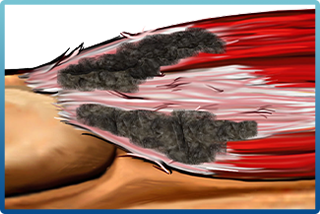
Diagrams and video courtesy of HydroCision, Inc.
Common Questions
It is a percutaneous procedure rather than open surgery. A small incision is still made to admit the needle, but there is no large exposure and no operating room admission.
It depends heavily on what your job demands of the arm. Desk-based work is typically resumed quickly; heavy gripping or lifting is reintroduced gradually under your physician's guidance.
Calcific deposits within a tendon are treatable. In one published elbow case, six-month follow-up ultrasound showed complete resolution of the calcific debris after treatment.
Yes. Candidacy depends on your imaging, symptom duration, general health and what you have already tried. Only an examining physician can determine whether it is appropriate for you.
This information is general and is not medical advice. Whether any procedure is appropriate for you can only be determined by a physician who has examined you and reviewed your imaging.